Echo
Design summary
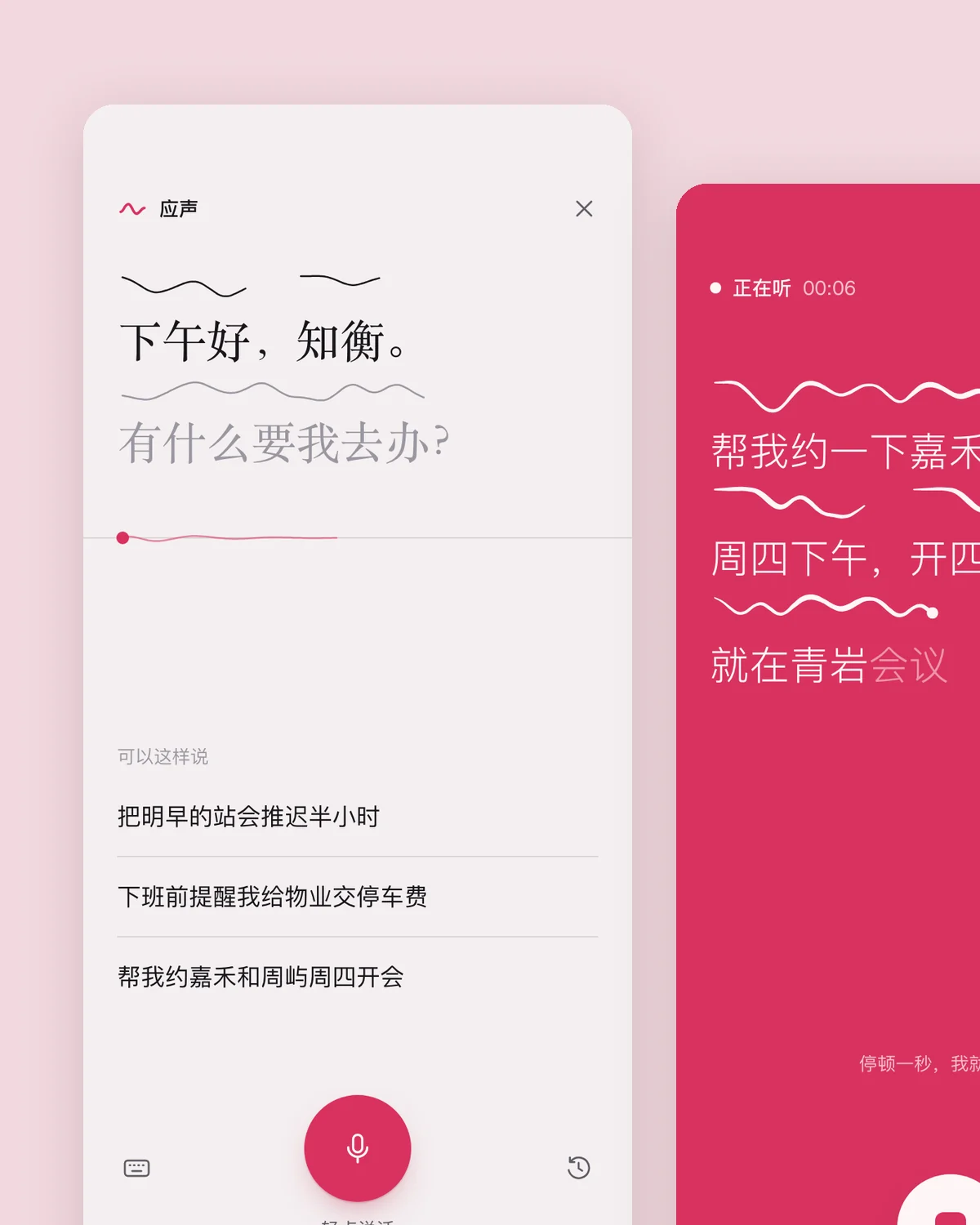
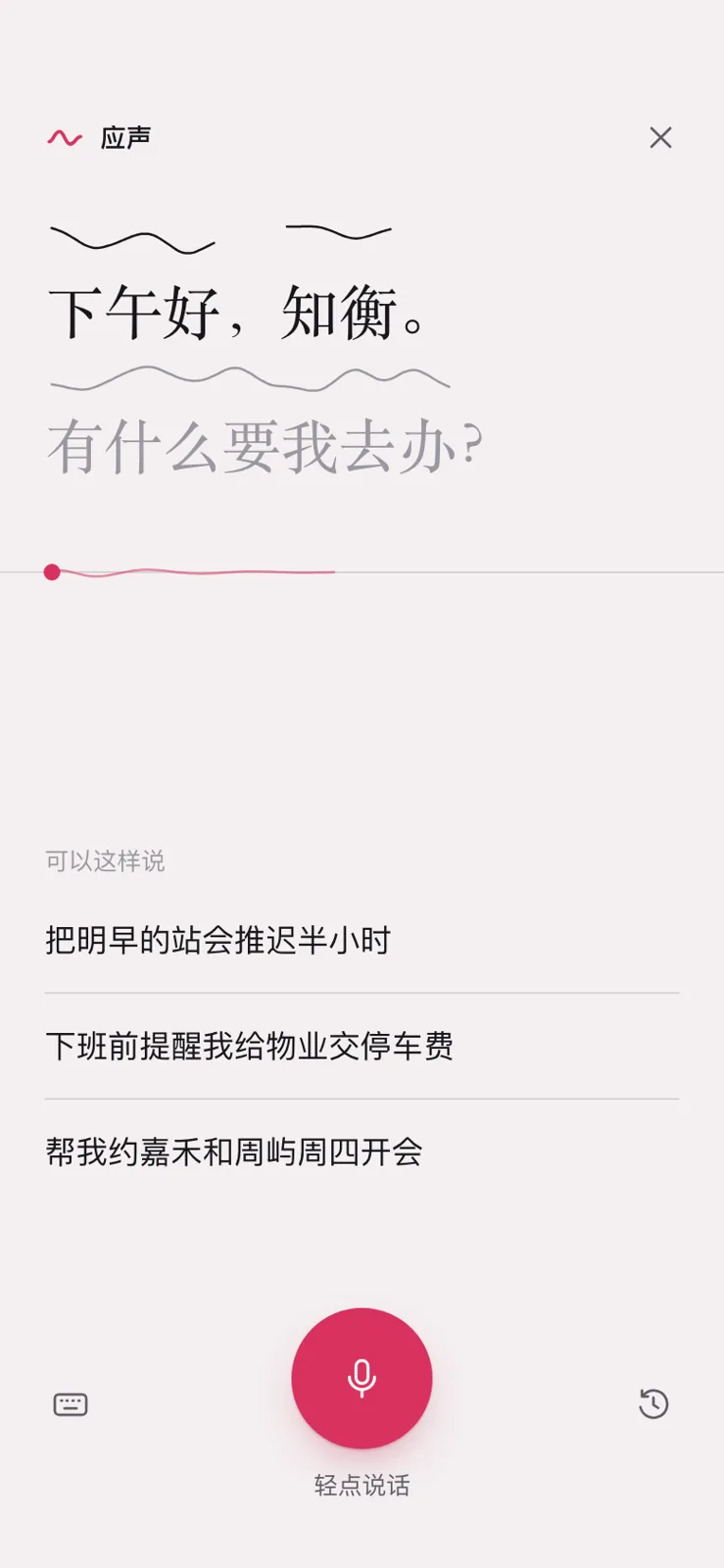
Echo turns a spoken errand into text with per-character tone contours across distinct waiting, listening, thinking, and answering states. The contours straighten into brackets around names, dates, and a meeting room before a meeting card with undo appears; the current prototype uses a scripted utterance and manual tone annotations rather than a microphone or speech recognition.
Verification
VerifiedThe main agent inspected three rounds of screenshots and intermediate frames, correcting jagged contours, bracket boundaries, and duplicate spinners, and confirmed that 12 characters fit on one line at 375px; the result card briefly underlines information extracted from the utterance in rose red.
Verification boundaryNo independent review or independent task walkthrough was performed; all four states share one scripted utterance, the contours are not live pitch, the answer has no real speech audio, and the other two suggestions have no separate flows.
Prompt
A full-screen mobile interface for an AI voice assistant (390×844), focused on visualizing sound. Waiting for speech, listening, thinking, and answering should each have a distinct form.
When answering, show a result card below, such as a meeting it has booked for you, rather than only a glowing orb. A purple-blue glowing orb is the most common default; avoid that approach.
Capture all four states. Deliver `index.html` and `screens.html` showing the states side by side.
View Chinese original
一个 AI 语音助手在手机上的全屏界面(390×844),重点是声音的可视化:等你说话、正在听、正在想、正在回答四个状态各有自己的形态。
回答时下方出现一张结果卡(例如帮你订好的会议),不要只是一个发光的球。紫蓝发光球是最常见的默认,不要做成那样。
截四个状态,交付 `index.html` 和并排展示的 `screens.html`。